Simple yet effective self-care strategies for women to improve both mental and physical health in daily life.

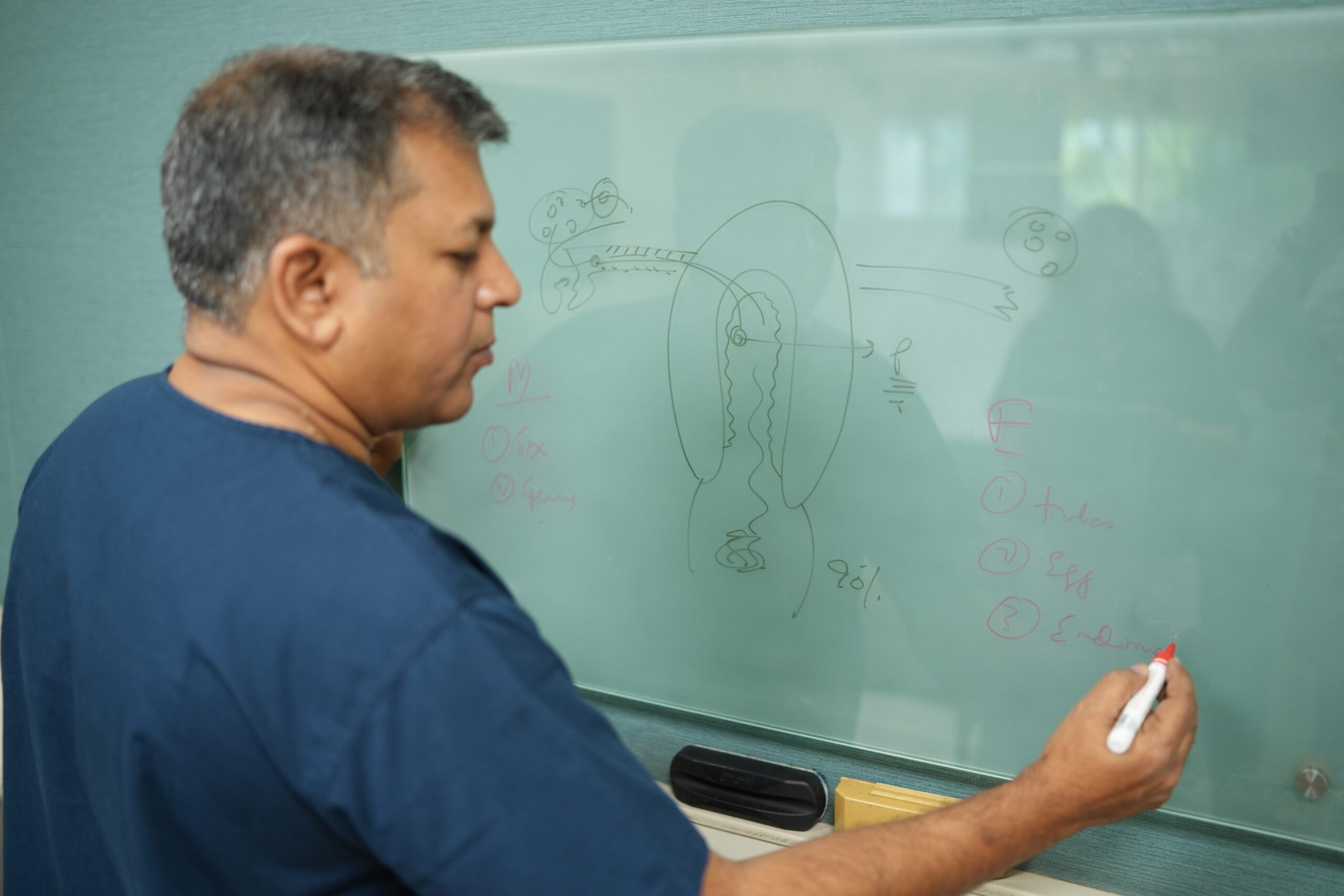
“Sane Advice in an Unsafe Time”
A Rapid-Fire Conversation with Dr Rohit Gutgutia
If you work in fertility long enough, you hear his name.
Dr Rohit Gutgutia is widely regarded as one of India’s leading healthcare entrepreneurs and is Medical Director at Nova IVF Fertility in India, the kind of doctor patients describe as “blunt but oddly calming”.
He runs one of the region’s busiest IVF units, thinks in numbers and probabilities, and still spends most of his day in scrubs, moving between scans, lab discussions and consults. He talks the way he works, with passion, patience and precision. His words often stay with his patients far longer than his schedule allows him to.
Ask him what he actually does, though, and the answer is strikingly simple:
“Somebody who understands reproduction better than most – and who is trying to give you sane advice.”
In a space that can feel commercial, confusing and emotionally explosive, he sees himself less as a salesman of treatment and more as a problem-solver who will sometimes tell you not to go ahead at all.
This rapid-fire Q&A is adapted from an unscripted conversation for Ikivana, to introduce the doctor behind our fertility connect calls, not as a distant expert, but as a very human mind at work.
“I’m not just a service provider. I’m your problem-solver.”
How would you introduce yourself to someone trying to conceive in the UK?
He doesn’t hesitate.
“I’d say I’m somebody who understands the process of reproduction better than most – and someone who is acutely aware of what goes on in people’s minds when they’re trying to get pregnant, including all the doubts.
But most importantly, I see myself as somebody trying to give sane advice.”
He talks about couples who technically could do more treatment – second children via donor eggs, extreme last-line options – and the moments where he has calmly said no.
“There are couples I have advised not to go ahead. If you already have one genetically-related child, and the second child would only be possible with donor eggs, you have to ask whether you want to spend the rest of your life wondering if you did the right thing.
Patients don’t just see you as a service provider. They see you as a problem-solver, an advisor. Whether you like it or not, you have to wear that hat.”
Inside the clinic: structure, emails and little happy notes
What is the first thing you do when you walk into the clinic in the morning?
“Switch on the computer, check my emails… and very often there’s something left on the desk from the previous day – a pregnancy report, or a small gift, or a photo from someone who conceived. Some bit of happy news.”
He calls himself a workaholic almost matter-of-factly.
“I’ve worked 16-17 hour days for about 30 years. A good day is one that starts early – around 8:30 – and ends by 6 or 6:30. Then I like to unwind with friends. That’s the ideal day. It doesn’t always happen.”
Black tea keeps him going: “One black, through the day.”
What would his patients call him in one word?
“Grumpy,” he laughs.
His team?
“Intelligent.”
From almost-surgeon to IVF: circumstances chose the field
Medicine was not a straight-line story.
“I wanted to be an administrator more than a doctor. In my family, administration meant managing healthcare businesses. At that time, there was no real ‘healthcare management’ – you were a doctor, and you managed your own practice.”
He initially set his sights on surgery, but life steered him into obstetrics and gynaecology instead. From there, he angled toward gynae-oncology, only for circumstances to redirect him again at the last moment.
Around the same time, a job appeared that would send him to Israel to train in IVF.
“I didn’t understand much about IVF then. What I knew was: there’s a lot of ultrasound, a lot of imaging, a lot of machines. It wasn’t a desk job; it was procedural, hands-on. That appealed to me.”
What looks like design in hindsight was, at the time, just a series of hard pivots and seized chances.
Life outside the clinic: quizzes, music and lost sports
When he is not being “doctor”, what is he most likely doing?
“I love quizzing. That means a lot of reading, a lot of fact-finding. These days it’s mostly Googling, earlier it was books.”
He used to be deeply into sports.
“I was a good football player, wicketkeeper, badminton player. Then, in late school years, life pushed me to switch hard into academics and professional stability. I went from 100 to zero on sports and buried myself in textbooks.
In hindsight, I wish it hadn’t been so extreme. Sports teach you team work and, very importantly, how to lose. A lot of kids today doing only individual sports don’t learn that.”
Fitness is the habit he is determined to reclaim.
When it comes to music, his top picks for long drives, focused work or long walks are Rahat Fateh Ali Khan, Jagjit Singh and Nusrat Fateh Ali Khan, with Jagjit as his lifelong favourite.
Travel vs scrubs?
“I’ve solved this,” he laughs. “My travel is also mostly scrubs now – or lounge-wear that feels like scrubs. I’ve been wearing tracks on flights for years. Only recently has fashion caught up.”
The part of IVF that still keeps him thinking
After thousands of cycles, what still fascinates him?
“At a micro level, the most intriguing thing is still not being able to tell a client whether a particular embryo will ‘stick’ or not. We can manage infertility; we can’t cure it. We understand stimulation, labs, transfers – but we don’t yet have a perfect metric for: will this embryo implant and stay?
From the client’s point of view, that’s all that really matters.”
He is honest about emotional distance and emotional limits.
“I can’t afford to be shattered by every failed transfer. Earlier in my career, I could tell you the name of every pregnancy. Now the numbers are different – we get disturbed when rates fall below 55 percent.
The cases that really stay with me are the ones with an extra layer – a cancer survivor, someone who has raised money with great difficulty, or parents who have lost a teenage child and are now trying again in their 40s or 50s. That’s where empathy hits hardest.”
For “vanilla IVF”, as he calls it, he believes in clarity more than sympathy.
“I tell patients I won’t be ‘sympathetic’. Being unable to conceive does not make you a lesser human. I will prep you honestly that the first cycle may not work. When people break down after one attempt, a part of me feels irritated – because they were told this. We’re not magicians, and even nature isn’t always that kind.”
Misconceptions about IVF: India vs the West
If he could change one misconception about IVF overnight?
“For Indian patients, it’s the belief that IVF is very damaging to the body. For the Western world, I think some still see it as ‘anti-nature’.
But IVF is not about ‘making babies’ in the sense people imagine. It’s about helping the egg and sperm meet in a controlled way. After that, the embryo is still accepted or rejected by the body according to nature. Implantation is still not fully in our hands. Nature is not out of the window.”
Indian and UK patients: the same urge, different pressures
Having seen both Indian and international patients, does he notice a difference?
“The basic urge to reproduce is universal. Once a couple decides they want a baby, the anxiety and the frailties are common everywhere.
In India, there is a huge social angle – not having children is still seen as an oddity. In the West, including for people of Indian origin, it’s more of a conscious or acceptable choice.”
The bigger difference, he says, is in how people handle logistics and boundaries.
“Patients from the UK or Western world are far more pragmatic. They take negatives more comfortably and will still compliment you for your effort. They’re very focussed on logistics – when to be in the clinic, how many days to take off work etc.
Indian patients are more likely to ask, ‘How much will it hurt?’ and to expect 24/7 access.”
What India can genuinely offer UK patients
From his perspective, what can India offer UK trying-to-conceive couples that they may not be getting at home?
He starts with continuity of care.
“In many Western units, one person scans you, another explains the process, someone else does the egg collection, another does the transfer. Outcomes can’t be the same as when one person is monitoring you from the first scan to the transfer.
In India, especially in our units, the model is still very doctor-dependent. The plus side is a seamless continuity of care. The minus is, if the doctor makes a mistake, it’s magnified.”
He is candid about scale and infrastructure too.
“We have huge numbers, and over time that has allowed many Indian units to invest heavily in equipment and lab technology – high-end ultrasound machines, multiple incubators, advanced lab tools. The combination of volume, experience and infrastructure is a real strength of our ecosystem.”
When does it make sense to come to India?
“If you’re an ‘easy’ patient with a 60-70 percent chance, it may not be worth the travel. But if you’ve been classified as a difficult case and know you’ll need multiple cycles, the cost difference is enormous – sometimes one-tenth.
For people of Indian origin already planning IVF, doing it in India with equivalent or better results, no waiting lists, and the option of a holiday built in can be a very logical choice.”
Second opinions: clarity, not magic
He has thought a lot about the role of second opinions.
“My opinion will genuinely differ from the first doctor’s in maybe 10 percent of cases. In the other 90 percent, it’s the same plan – just communicated differently.
Second opinions are useful when they bring clarity: explain why IVF was advised, what the plan actually is, and what the realistic odds look like. They become confusing when people expect a completely different answer as proof that the first one was ‘wrong’.”
This is also where he sees Ikivana’s value for UK patients.
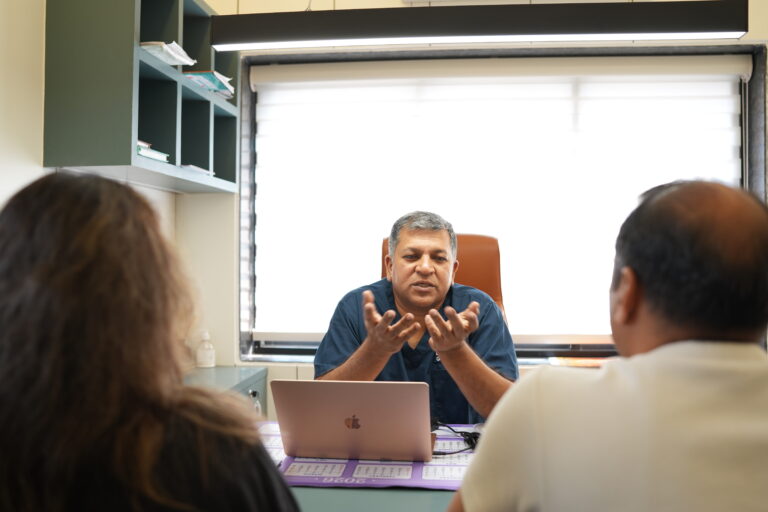
“Most people who come to me from the UK feel they were not fully communicated with – about why IVF is needed, or what the process will be like. Through Ikivana, we can use these one-on-one calls to give them complete clarity.
A small subset might come to India and do IVF with me because the vibe feels right. But the majority will go back and do treatment in their original clinic – now with a clear plan in hand. My take-home is: I’ve helped guide more couples onto their own fertility journey, even if I don’t treat them personally.”
The future: freezing, later parenthood and smarter embryos
What does he see coming in the next decade?
“Marriage as an institution is getting more fragile, and people are delaying parenthood. So more and more healthy people will freeze eggs and sperm in their 20s and 30s, and then use IVF later – not because of disease, but because of timing.
In the future, I wouldn’t be surprised if a significant percentage of couples have their children through IVF simply because they froze their gametes earlier.”
On the science side, he is most interested in functional embryo assessment.
“Right now we select embryos based on how they look, sometimes with genetic screening. The next breakthrough will be functional assessment – non-invasive ways, maybe AI-driven, to tell us whether an embryo is truly worth transferring.
That could flip the pyramid: instead of one egg collection giving three transfers, you might do multiple collections to get one truly meaningful embryo and one transfer that counts.”
And what is a “good outcome” in his eyes?
“The birth of a healthy baby. Nothing less. We can’t control it fully, but that’s what we’re all working towards.”
What keeps him grounded
In a field where outcomes can make or break people’s hopes, what keeps him on the ground?
“My results,” he says simply. “Any day I feel I’m going sky-high, the next day there will be two unexpected negatives. I don’t need anything external to keep me humble.
Most doctors can afford to fly in the air – surgeons, obstetricians, they get their desired outcome 99 times out of 100. In IVF and cancer, you are acutely aware of your limitations. That, in a way, is a blessing.”
Practical. Doable. Reproducible. Without drama.
That is how he wants his work to be remembered ten years from now. At Ikivana, it is also why he is at the centre of what we do for patients who are tired of waiting lists, high fees and vague reassurance.
He brings something rare to modern fertility care: the volume and experience of a high-traffic IVF unit, paired with a very direct, very human way of speaking. He will tell you when to move, when to pause, and when another cycle is simply not worth the emotional and financial cost. No fluff, no theatrics, just clear thinking and a plan.
If you would like this kind of mind on your side, you can book a one-on-one fertility connect call with him through Ikivana.com and walk into your next step feeling more informed, and a little less alone.
Sign up for appointment!
Book a virtual appointment with our doctors.




Comments
adamgordon
Wow, cool post, thanks for sharing.
miaqueen
Thanks for sharing this information is useful for us.